Photo: Peter FairleyDC in SF: A feeder head, rectifier, and output smoother atop a pole in San Francisco's South of Market neighborhood is visible evidence of the city's DC grid.
Nikola Tesla’s alternating current may have “won” the War of Currents at the end of the 19th Century, but the defeated incumbent—direct-current distribution, aggressively championed by Thomas Edison—endured. As historian of technology Thomas P. Hughes observed in his influential essay on the evolution of large technological systems, the War of Currents ended “not with victor and vanquished, but with the invention of devices making possible the interconnection of the two systems.” Remnants of DC power distribution kept performing their assigned tasks for decades as the AC grid thickened around them.
In fact, a few live on to this day. One of the best examples is in San Francisco, where 250-volt DC power still flows through underground and overhead cables across the city. These DC lines peacefully coexist with their AC counterparts; you can see this mix of currents straddling utility poles in the city’s South of Market district. DC’s perseverance in that neighborhood seems fitting, for it was just a few blocks away that the tiny California Electric Light Co.—a forebear to California’s dominant Pacific Gas and Electric (PG&E)—became the first power company in the United States, and possibly the world, to supply electricity to multiple customers from a central generating station. It was in September 1879—a full three years before Edison turned on his famous Pearl Street generating station in New York City—that California Electric began burning coal, raising steam, and driving dynamos in a wooden shack at the corner of Fourth and Market streets to feed current to its customers’ electric lights.
While DC continues to race through San Francisco power lines at nearly the speed of light, it does so anonymously. You’ll find no reference to DC power distribution in PG&E’s annual reports or on its websites. Even some utility engineers are unaware of its existence, which raises a curious question: Why is the inheritor of this legacy, the mighty and sophisticated PG&E, still bothering with DC distribution 133 years later?
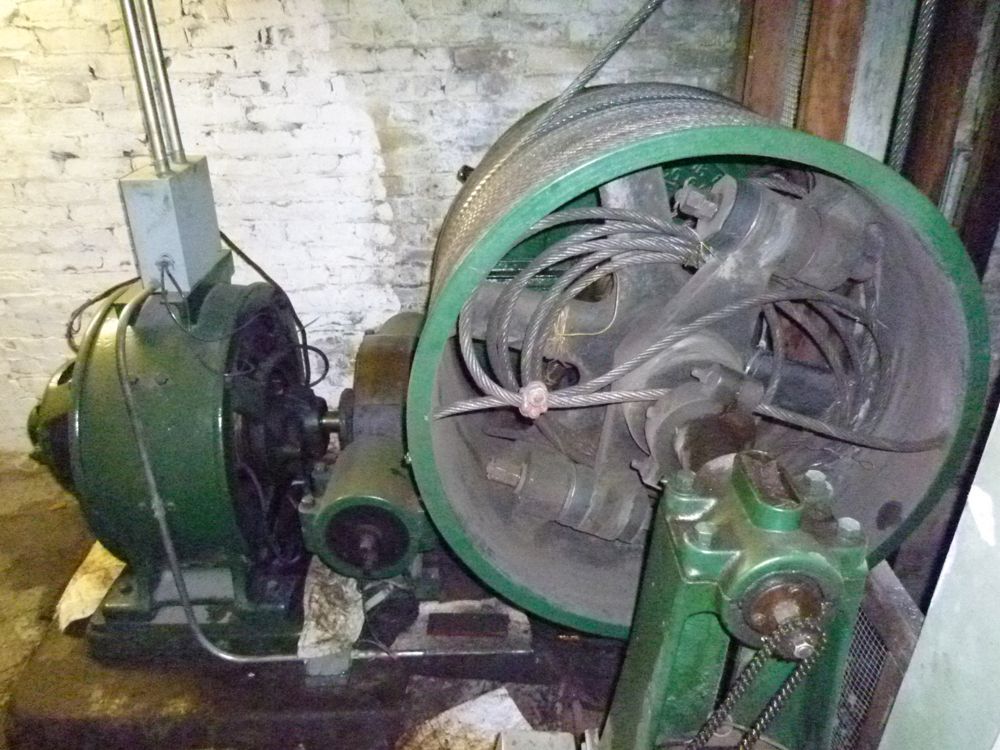
Photo: Richard BlaskaOld Elevator: Decades old winding drum elevators need DC, so the city maintains a DC grid.
DC endures in San Francisco because more than 900 of PG&E’s customers still need it. Most of the utility’s customers transitioned to AC lightbulbs and appliances easily enough as competing power distributors coalesced within PG&E and harmonized their equipment around AC. But for some of these building owners, however, elevators were a problem.
DC-driven winding-drum elevators—the leading design until the 1930s—use a DC motor in the basement that winds and unwinds the elevator’s steel cable on a steel drum, thus lifting and lowering the car from pulleys atop the elevator shaft. DC drive was the only way to go at the time for a speedy elevator, because only DC could deliver variable-speed operation for smooth starts and stops. The DC motors were also energy efficient, capable of something that has only recently become possible with modern elevator designs: regenerating power when the elevator descends.
However, safety was a weak point. If a winding drum’s control system fails, its motor can drive the elevator through the roof, according to San Francisco–based elevator consultant Richard Blaska. As a result, says Blaska, new installation of winding-drum elevators was banned in the 1940s and 1950s in favor of traction elevators, whose cable will simply slip and hold the car at the top floor if the control system fails. Traction elevators can be engineered for either AC or DC operation.
Existing DC winding-drum elevators, however, have stubbornly resisted exile to the scrap heap, in no small part with support from local elevator repair firms such as Erik Bleyle’s. Bleyle Elevator makes replacement parts, rebuilds DC motors, and designs custom circuits to sustain these machines from a bygone era. Bleyle admits that repairs can be pricey, especially hand-rewinding a DC motor, which can run between US $30 000 and $40 000. But he says even a refurbished motor looks cheap compared with the $500 000 cost of replacing the elevator, not to mention the months of involuntary stair climbing during the upgrade.
“Usually people just go for the motor,” says Bleyle.
Photo: Peter FairleyPG&E’s DC Man: Steve Austin is the go to guy for problems with the DC grid. He lugs a drill around as a test instrument.
For most of the past century, PG&E has supplied San Francisco’s DC elevators via a citywide DC grid. While its origins are obscure, this DC grid likely came together organically as neighboring—and, in some cases, competing—utilities absorbed one another and wiring coalesced into one great citywide circuit.
“Some of the pieces of the DC grid were actually part of the very first original systems,” says Tom Cannon, PG&E’s principal engineer for electric asset strategy in San Francisco.
By the mid-20th century, large rectifiers installed at two downtown substations supplied the current, pushing 250-V DC onto a rectangular loop of 3.6-centimeter-diameter cable. Local lines branched off this loop in a meshed pattern that, much like the meshed communications networks that form the Internet, provided redundant paths for power to flow around cable breaks and blown fuses.
Operating the meshed grid came with unique challenges, thanks to DC’s oddball status as the 20th century wore on. For example, stray current from DC lines would wind up flowing down the core of copper neutrals in the AC distribution grid, invisibly corroding them from the inside out. “It would look fine, but strike it with a hammer and it would shatter,” says Steve Austin, PG&E’s first line supervisor for electric operation, maintenance, and construction, and the million-dollar man when it comes to keeping DC power flowing. The DC grid was also always difficult to troubleshoot because faults are hard to localize on a single large circuit—a challenge that Austin says is compounded by the scant support this forgotten technology gets from equipment vendors. Austin adapted a circa-1990 AC/DC hammer drill to create his own diagnostic tool for so-called phantom voltage—tiny dribbles of DC flowing across blown fuses that can hoodwink unsuspecting “troublemen” and their trusty voltmeters. Austin knows he’s found a phantom when he clips his modified Black & Decker Macho III hammer drill onto a circuit, pulls its trigger, and gets a whimper instead of a roar.
As the citywide DC network aged, cables failed and phantoms multiplied, making maintenance costly and threatening both reliability and safety. The final straw came in 2009, when a 1920s-era DC cable overheated at a splice junction under the intersection of Polk and O’Farrell streets, melting the seals on a neighboring AC switch and igniting the oil within it. The grid was blind to the ensuing crisis below San Francisco’s Tenderloin district until the blaze blew off a manhole cover and shot flames 9 meters into the air.
“When you had a failure out there like a fire in a manhole, the DC grid saw it as a load and just kept on pumping power at it,” says Austin. The Tenderloin fire provided fuel for critics of PG&E’s maintenance record and prompted the utility to accelerate and complete an ongoing redesign of its DC supply system. PG&E finished the job and shut down its two old rectifiers at the end of 2010.
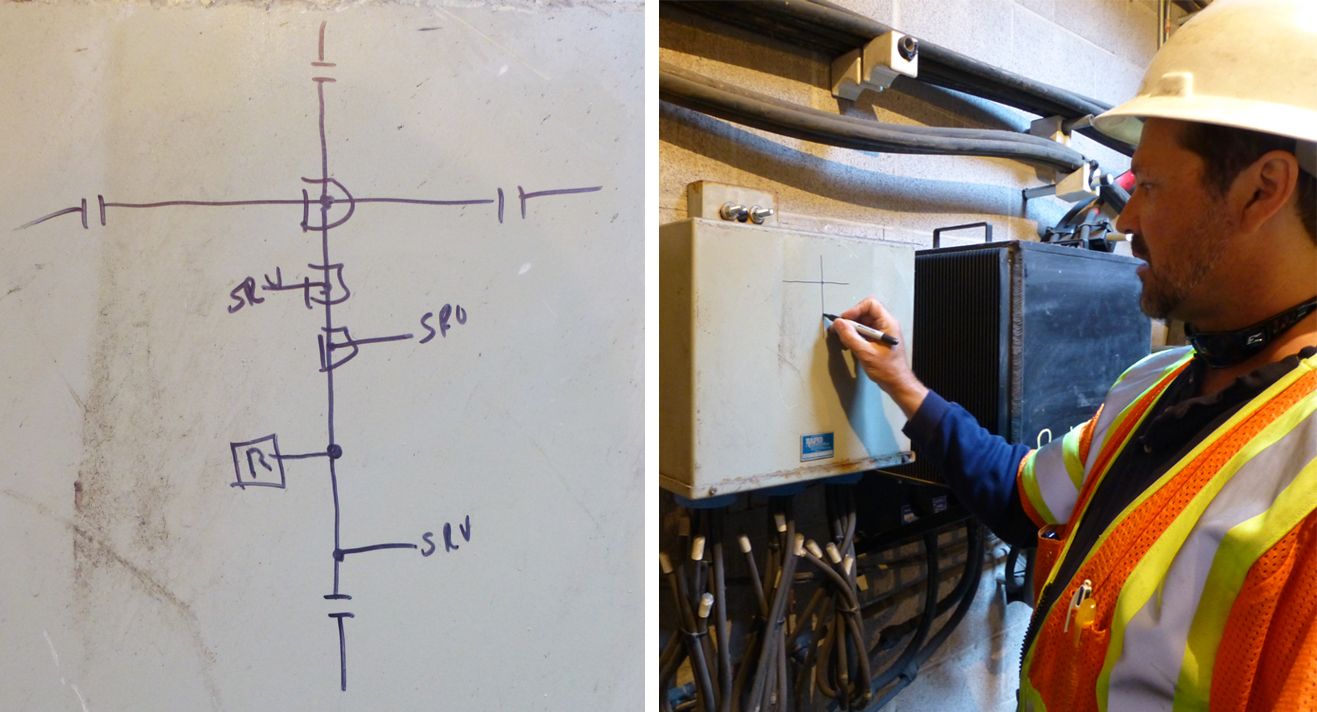
Photo: Peter FairleyYou Are Here: PG&E’s Steve Austin draws out a DC circuit map.
PG&E upgraded San Francisco’s DC supply system with a back-to-the-future redesign. Austin explained the islands to IEEE Spectrum schematically in an impromptu drawing on an underground equipment box in the South of Market district. The company broke up the DC network into islands serving 7 to 10 customers each by deliberately introducing breaks in the network mesh. At first glance, the resulting 171 power islands resemble the short-range DC grids of the 19th century. But instead of steam-driven dynamos, today’s neighborhood-scale circuits get their DC power from the AC grid. Each is equipped with a rectifier plugged into the local AC distribution system.
This islanding solution safely retained older DC lines, even paper- and lead-wrapped cables from the early 1900s, by requiring them to carry less current. It also improved power quality by providing a means of regulating delivered voltage—a recurring challenge for the citywide network. And islanding accelerated troubleshooting by isolating line faults within a handful of city blocks.
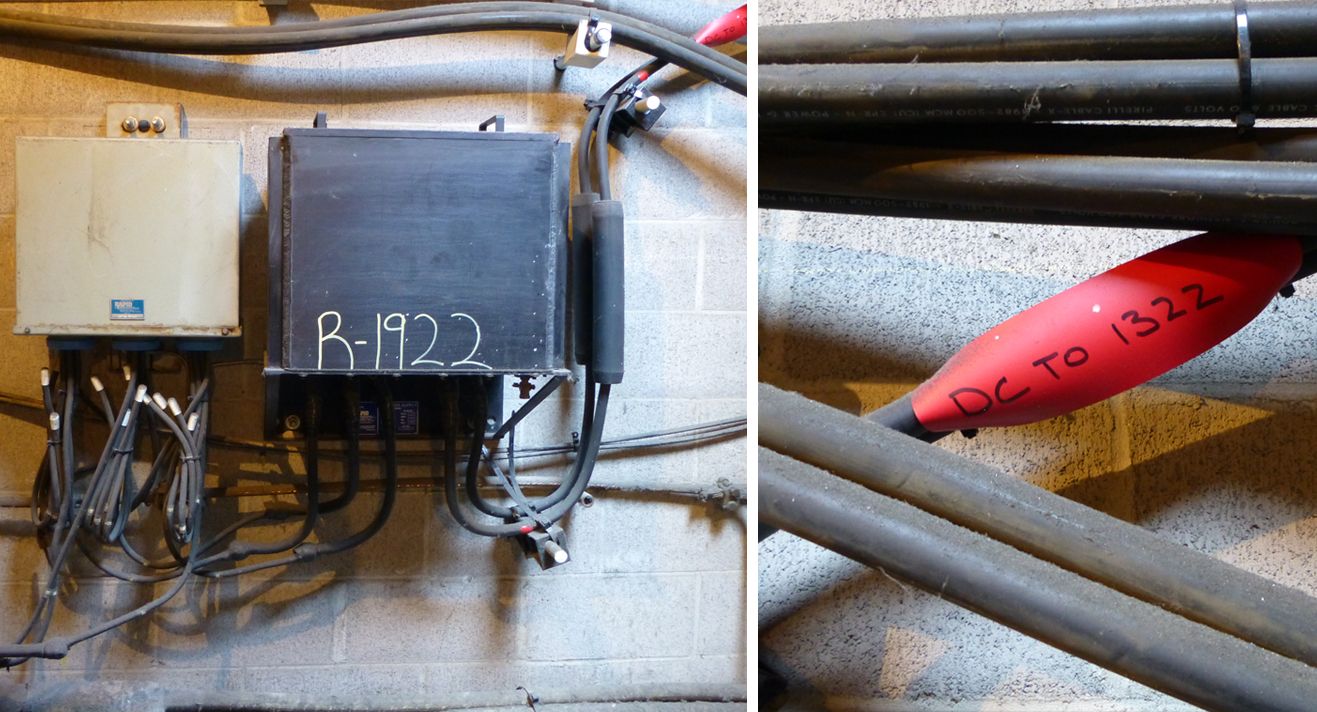
Photo: Peter FairleyUnderground Equipment: A subsurface DC output smoother and rectifier [left] link to a feeder line [right] that connects to a customer.
In a subsurface chamber under the sidewalk along Second Street in the South of Market district, electricity entering from the AC distribution grid at 12 000 volts AC is transformed and converted to deliver 240-V AC and 250-V AC power to the surrounding city blocks. To produce DC power, a transformer [the small beige box] first drops the AC to 175 V, which then feeds the 50-kilowatt rectifier [the larger black box] to make 250-V DC. Cables exiting through a conduit in the wall to the right of the rectification equipment distribute the DC power to the area’s island of six customers on three city blocks.
Photo: Chicago History Museum/Getty ImagesLuminous: AC powered electric lighting won at the 1893 Chicago World’s Fair.
DC endured through the 20th century in many cities, but it is losing ground in the 21st century. With the exception of a few holdouts, such as San Francisco, AC-minded cities are finally clearing away lingering DC lines. Consolidated Edison in New York cut off its last DC customer in 2007, for example, and DC’s days are numbered in Chicago—the home of the of the 1893 World's Fair, which was triumphantly powered by Tesla and Westinghouse's AC system.
This is not, of course, the end of DC power. It will endure within the bowels of these cities’ oldest buildings, as DC customers install their own rectifiers to supply their ancient elevators.
Could holdouts such as San Francisco ultimately have the last laugh? The spread of both DC generators (such as photovoltaic panels) and DC loads (such as cellphones, flat-panel televisions, LED lights, and even electric cars) is inspiring a small but growing niche for DC microgrids that link the two together. If such building-wide circuits grow into neighborhood grids and, ultimately, meld together to form citywide DC grids, this circuit of electrical history will finally be closed.
PG&E’s distribution chiefs in San Francisco aren’t counting on it. Then again, stranger things have happened.
About the Author
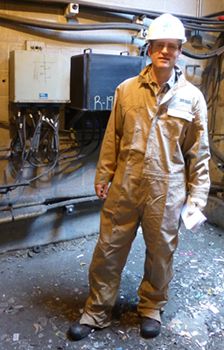
Photo: Steve Austin
Peter Fairley is an IEEE Spectrum contributing editor based in Victoria, B.C., Canada. Besides diving deep into the bowels of San Francisco’s subterranean systems, he explores the technological and economic issues of energy. In the November 2011 special report on the future of nuclear power after Fukushima, he analyzed the accident’s effect on policy in Germany and China.
Direct electricity use of the Internet is probably around 10% of total electricity consumption, said Jon KoomeyResearch Fellow at Stanford University but he immediately added that the number does not tell us very much.
Koomey, who has been studying Internet energy effects since 2000, was a keynote speaker at Google’s ‘How green is the Internet?’ summit, held June 6 at the Googleplex. There experts discussed the system-wide energy implications of information technology.
First of all there is the data gap. Ironically, IT -master of data collection- falls short when it comes to gathering extensive and well-defined data about its own energy consumption. Secondly, electricity is only a part of the Internet’s total energy cost, fabrication of equipment should also be taken into account. Last and perhaps most important when it comes to getting a good measure of the Internet’s overall environmental impact are system effects. These are IT-enabled energy savings in larger scale systems like transportation or manufacturing.
physical internet Of all the different network components the ones that consume the most electricity are end user devices. Per unit they don’t use much, desktops and notebooks run on 200 and 70 kWh/year respectively. But the numbers add up: 1.6 billion connected PCs and notebooks and 6 billion mobile devices.
Koomey notes that energy efficiency of computing has doubled every 1.5 years for more than six decades bringing us low-power devices like phones (2 kWh/year) and tablets (12 kWh/year). Reduced power requirements foster a shift in the product’s life cycle energy costs. Electricity intensive devices gobble up 80% of their total energy in the use stage against 20% in the manufacturing stage. For low-power devices it’s the other way around, 80% is embodied energy. So in terms of energy savings the highest gains can be obtained in the production process.
Data centers The second largest power users are the data centers. Together they consume 1 to 2% of the world’s electricity,according to Eric Masanet Associate Professor at Northwestern University. Masanet told the audience that massive energy saving can be made by moving business applications like e-mail and productivity software to the cloud. Many companies host their own small inefficient server rooms. Migrating locally hosted services to large datacenters could reduce energy cost by 87%. The benefits are the result of replacing millions of inefficient servers for a significant smaller number of efficient ones.
Data gap Masanet agrees with Koomey that there is not enough data to get a good grip on the environmental impact of the Internet. Another difficulty is the lack of standardized research methods. Disparate system boundaries and nontransparent use of data makes it difficult to compare and integrate different studies. To address the problem Masanet and his fellows created CLEER, a publically available model for assessing energy effects of cloud computing.
System effects Even though the Internet consumes a lot of electricity its net environmental impact can be a positive one, Koomey pointed out. Information technology can realize energy savings in larger systems. One consequence of IT is dematerialization, moving bits instead of atoms. To illustrate Koomey referred to a study by him and two colleagues in which they compared the environmental effect of buying a CD versus downloading music. Depending on the scenario downloading was 40% to 80% less harmful in terms of CO2 emissions. Another example is smart parking. A sensor network covering parking spaces can alert drivers of an empty parking spot. That information will reduce the amount of time drivers are circling around looking for a place to park. A network covering 40.000 spots consumes only 15W annually while contributing to reducing CO2 emissions of cars.